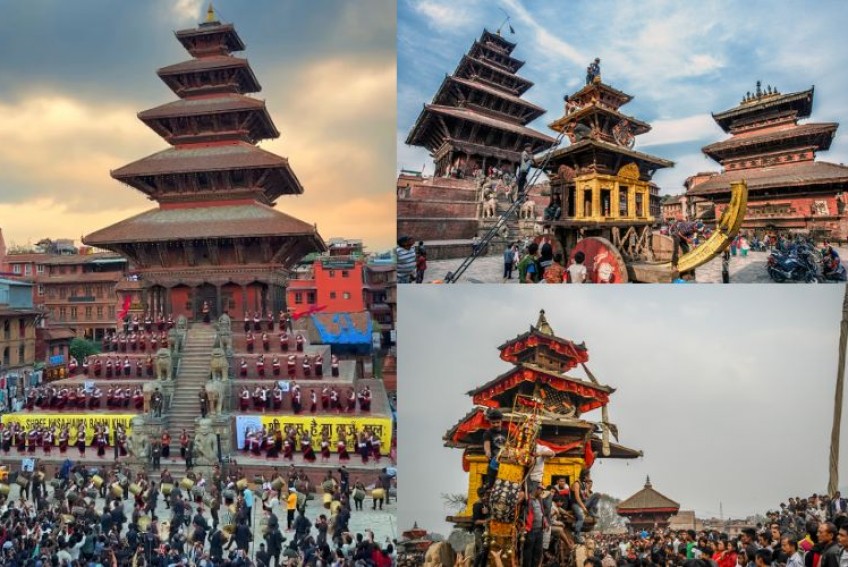
As the historic city of Bhaktapur stirs to the deep, resonant rhythms of traditional drums, Bisket Jatra 2026 has officially begun. The air fills with anticipation as crowds gather in narrow brick-paved lanes, marking the onset of one of Nepal’s most powerful and immersive cultural festivals.
Celebrated annually in mid-April, Bisket Jatra heralds the Nepali New Year (Bikram Sambat) through a rare solar-based tradition, setting it apart from the predominantly lunar festivals observed across the country.
A Festival Rooted in Myth and Time
Bisket Jatra, also known as Biska Jatra is deeply embedded in the cultural fabric of the Newar community. With origins tracing back to the Malla period, the festival has been preserved and adapted across generations as a living heritage rather than a staged event.
The name itself is often associated with the slaying of serpents, a reference drawn from local oral traditions.
The Legend Behind the Festival
According to folklore, a princess was cursed such that every man she married died mysteriously on their wedding night. It was eventually revealed that serpents were responsible for these deaths. A courageous prince managed to slay the serpents, breaking the curse and restoring peace.
This story of triumph over hidden danger continues to symbolise renewal, protection, and the victory of life over chaos, aligning closely with the spirit of the New Year.

Ritual Rhythms: The Sound of Dhime
The festival atmosphere builds through the powerful beats of the Dhime, a traditional Newar drum integral to ritual life.
Rather than a singular opening, these performances unfold across the festival, energising both participants and spectators alike.
Major Highlights of Bisket Jatra
1. The Chariot Procession of Bhairab and Bhadrakali
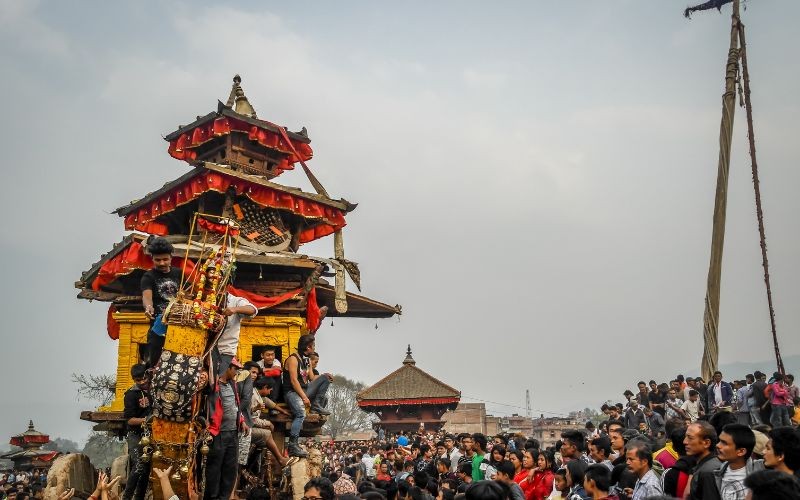
At the heart of the festival lies the dramatic procession of the deities Bhairab and Bhadrakali, whose towering wooden chariots are pulled through the city’s ancient streets.
For visitors, this is among the most electrifying spectacles in Nepal, one that is raw, kinetic, and deeply rooted in tradition.
2. The Rise and Fall of the Yosin (Lingo Pole)
One of the most iconic rituals is the erection of the Yosin, a towering ceremonial pole raised in Taumadi Square.
The dramatic toppling of the pole marks a pivotal moment in the festival calendar.

3. Sindoor Jatra in Madhyapur Thimi
In nearby Madhyapur Thimi, celebrations take on a vibrant hue during Sindoor Jatra.
This parallel celebration offers a striking visual contrast to the rituals in Bhaktapur.
4. Bode’s Tongue-Piercing Ritual
In the settlement of Bode, a unique and intense act of devotion takes place.
It remains one of the most extraordinary ritual practices associated with the festival.

Cultural and Tourism Significance
Bisket Jatra stands apart as a community-led festival, not curated for tourism but lived by the people themselves. Its authenticity lies in its unpredictability and its deep-rooted connection to place and identity.
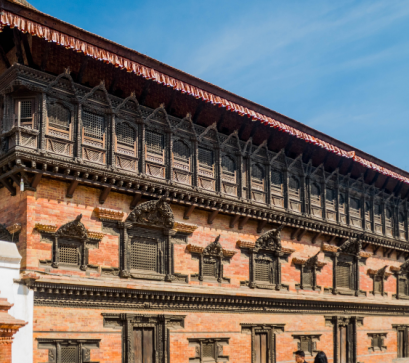
Set against the backdrop of Bhaktapur’s UNESCO-listed heritage; its temples, courtyards, and medieval architecture, the festival becomes an immersive cultural experience.
For travellers, it offers:
When to Experience Bisket Jatra 2026
Note: Dates may vary slightly in accordance with the traditional calendar every year.
Why Bisket Jatra Belongs on Every Traveller’s List
Bisket Jatra is not a spectacle designed for observation, it is a festival that engulfs you.
Here,
For those seeking authenticity beyond curated experiences, Bisket Jatra reveals Nepal at its most powerful, visceral, and alive.
PC: Wikimedia Commons
Also Read