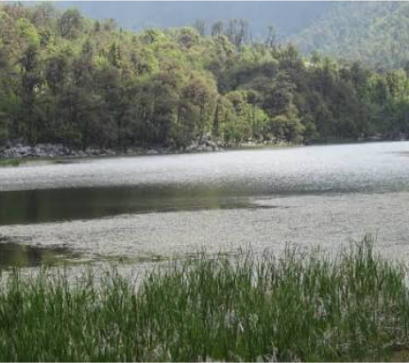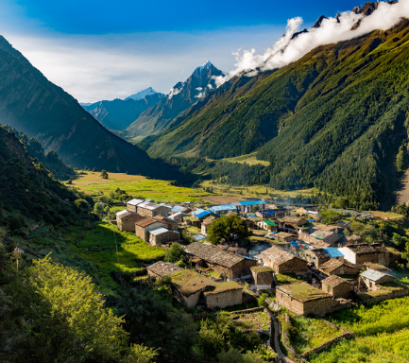
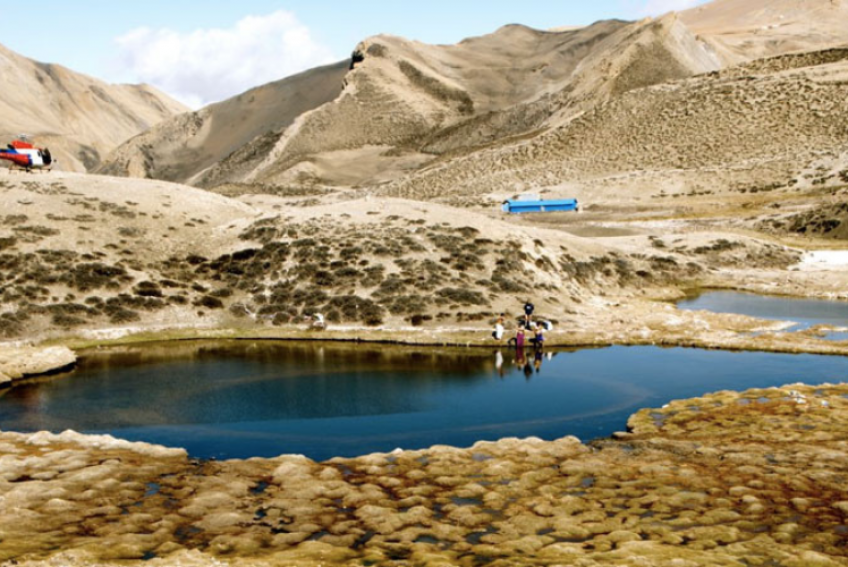
High in the remote trans-Himalayan desert of Upper Mustang lies Damodar Kunda, a sacred lake revered by both Hindus and Buddhists. Resting at an altitude of around 4,890 metres, this icy-blue water body is believed to be a powerful spiritual site where faith, mythology, and Himalayan geography merge into one of Nepal’s most profound pilgrimage journeys.
Located in the restricted region of Upper Mustang near the Nepal-Tibet border, Damodar Kunda sits within a stark, high-altitude desert landscape shaped by wind, rock, and snow. The lake complex consists of multiple ponds, with pilgrims traditionally bathing in the largest pools as part of ritual purification practices.
For devotees, this is a tirtha (holy pilgrimage site) believed to hold the power to cleanse karma and guide the soul toward liberation.
The name Damodar is deeply rooted in Vaishnava tradition, referring to Lord Krishna in his childhood form when he was bound with a rope (dama + udara).
According to Puranic traditions, this Himalayan tirtha is associated with Lord Krishna’s divine instruction for liberation, where sacred waters are believed to dissolve the bonds of worldly existence. Many pilgrims interpret the lake as a symbolic gateway to moksha (freedom from rebirth).
One of the most significant beliefs linked to Damodar Kunda is its association with the origin of Shaligram Shila.
The nearby Kali Gandaki basin is the only natural source of these sacred ammonite fossils, worshipped as manifestations of Lord Vishnu. According to traditional narratives, divine forces shaped these stones into sacred forms, making the region one of the most important Vaishnava pilgrimage landscapes in the world.
Reaching Damodar Kunda is a demanding Himalayan journey that tests endurance and devotion.
The final ascent involves high-altitude passes above 5,000 metres, making acclimatisation essential.
Permit Required: Restricted Area Permit (Upper Mustang) and Annapurna Conservation Area Permit (ACAP)
At nearly 5,000 metres above sea level, Damodar Kunda presents serious risks of altitude sickness. The thin air, unpredictable weather, and remote terrain require careful preparation. Despite its spiritual significance, the journey is physically demanding and not suitable for inexperienced trekkers without acclimatisation.
Despite its remoteness, Damodar Kunda continues to attract thousands of pilgrims annually, particularly during sacred festival periods. Many travellers arrive not just for religious merit, but for the rare experience of standing in one of Nepal’s most isolated and spiritually significant landscapes.
The journey is often described as a passage through faith, endurance, and Himalayan silence, where mythology and geography coexist.
Damodar Kunda is a living pilgrimage landscape where ancient Hindu mythology, Shaligram traditions, and Himalayan geography converge.
For travellers seeking deeper meaning in Nepal’s mountains, it represents one of the most powerful intersections of spiritual belief, cultural heritage, and extreme adventure travel.
PC: Himalaya Journey Treks
Also Read