
Nepal’s diverse geography from subtropical plains to temperate mid-hills creates the ideal conditions for a remarkable variety of seasonal fruits. Many of these are not commercially cultivated at scale; instead, they are foraged, locally grown, or harvested in small quantities, appearing only briefly each year.
For travellers, encountering these fruits is less about seeking them out in shops and more about chance discoveries: a roadside vendor with a paper cone of berries, or a quiet forest trail dotted with edible shrubs.
Peak Season: April to May
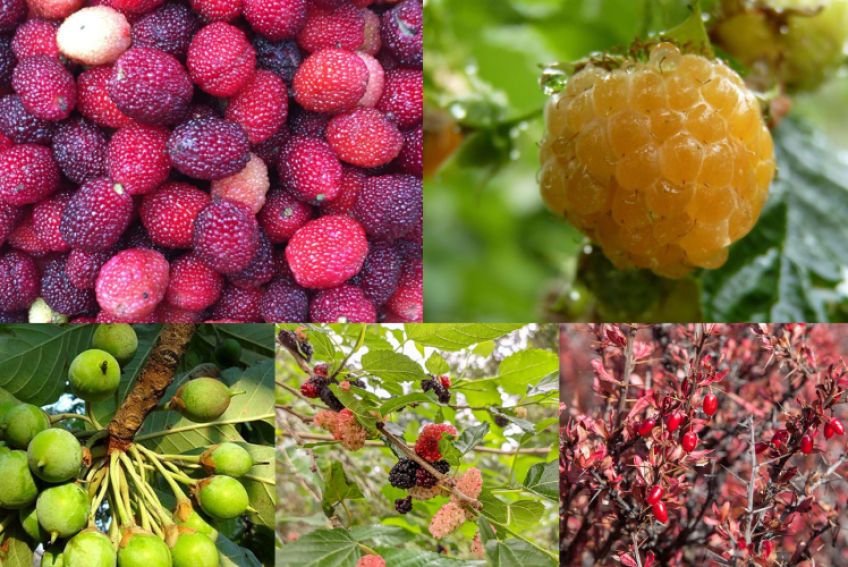
Among Nepal’s most iconic seasonal fruits, kafal (Myrica esculenta) holds a nostalgic place in local culture. Small, deep red, and delicately textured, it is widely foraged from mid-hill forests between 1,000 and 2,000 metres.
Flavour profile:
A balanced interplay of sweet and tangy, often enhanced with a pinch of salt and chilli.
Where to experience it:

Peak Season: April to June
The golden Himalayan raspberry (Rubus ellipticus) stands out for its soft yellow hue and fragile structure. It grows abundantly along forest edges and open trails across Nepal’s mid-hills.
Flavour profile:
Mildly sweet with a subtle tartness, gentler than its red counterparts.
Where to experience it:
Peak Season: March to May
Chutro (Berberis asiatica) grows on thorny shrubs scattered across Nepal’s hills. Though less widely recognised, it remains valued in rural communities for both its culinary and traditional uses.
Flavour profile:
Sharply tangy and refreshing, typically consumed in small quantities or used in pickles.
Where to experience it:

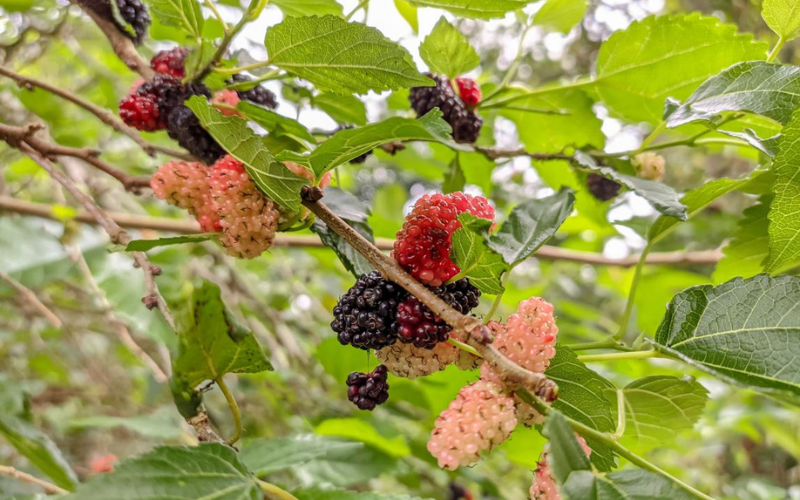
Kimbu (Mulberry)
Peak Season: March to April
Kimbu (Morus species) is a familiar sight in village gardens and urban fringes rather than a purely wild fruit. Often grown near homes, it bridges the gap between cultivated and seasonal produce.
Flavour profile:
Sweet, juicy, and slightly earthy, with a tendency to stain fingers a deep purple.
Where to experience it:
Chiuri (Indian Butter Tree)
Peak Season: May to July
Chiuri (Diploknema butyracea) is culturally significant, particularly among the Chepang community of central Nepal. While the fruit pulp is edible, the tree is primarily valued for the rich butter extracted from its seeds.
Flavour profile:
The pulp is mildly sweet, though the seed-derived butter is its most important product.
Where to experience it:

More Seasonal Fruits to Look Out For
Depending on region and timing, travellers may also encounter:
A Seasonal Experience Worth Chasing
What makes these fruits truly special is their fleeting nature. They are rarely found in supermarkets or formal retail spaces. Instead, they emerge briefly in roadside stalls, village markets, and forest paths—before disappearing with the changing season.
For travellers, tasting these fruits becomes an experience shaped by timing and place: a pause during a hillside walk, a spontaneous roadside stop, or a quiet exchange with a local vendor.
In Nepal, food is inseparable from landscape and seasonality. These fruits are more than simple refreshments—they are expressions of geography, tradition, and time.
Also Read


.jpg)