

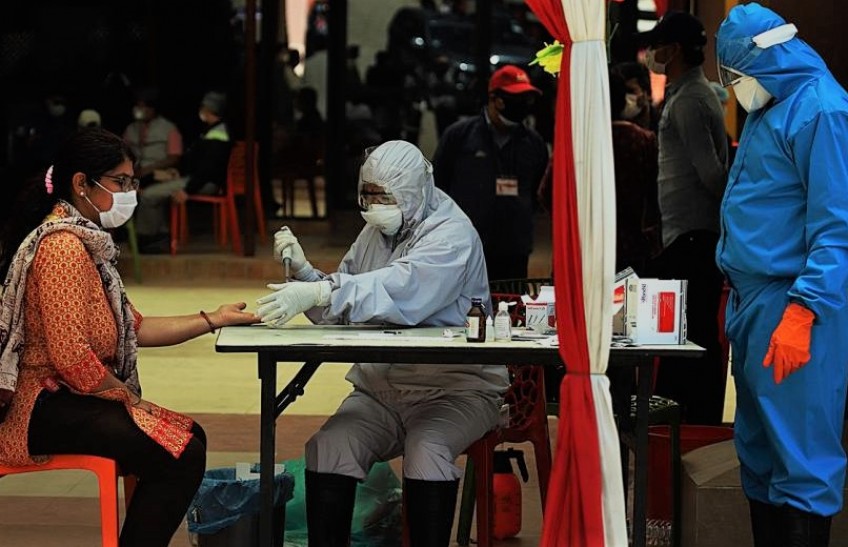
 Source::Xinhuanet
XINHUA/RSS
New coronavirus infections have been declining in Nepal in recent days, however, the country is still facing many challenges as the daily infections remain high.
The country reported 8,000-9,000 cases on most days in May before a decline was shown in the last few days since the second wave of infections started in early April. The tally has fallen since Wednesday below 7,000 cases per day, with 4,311 infections recorded on Saturday.
Health officials and experts, however, are cautious about the downward trend. "The stabilization in cases or slight decline does not mean that the situation has come under control fully," Prime Minister KP Sharma Oli told the foreign press on Thursday.
Health facilities had been pushed to their limit when the coronavirus sickened more than 8,000 people each day for many days and left many dead, and hospitals had to turn away patients due to a lack of medical oxygen and beds. The authorities have enforced a lockdown in most districts of the country which in no doubt has helped stabilize new infections.
Likewise, an increasing supply of oxygen cylinders, oxygen concentrators, other medical equipment and hospital beds through joint efforts of the government, private sector, non governmental organizations and foreign governments has also contributed to the eased situation, according to officials.
"Our assessment is that the case loads are still in the peak and it will remain so for some time before declining," said Krishna Prasad Paudel, director of the epidemiology and disease control division under the Health Ministry. "It is necessary for Nepal to continue the existing measures of lockdown and social distancing along with testing and isolating the infected people to bring down the cases for a longer term," he told Xinhua.
According to the Home Ministry, the prohibitory measures have been enforced in 75 of 77 districts in the country.
Even though a sign of slowing has been seen mostly due to the prohibitory measures, less focus on contacts tracing, low testing and lack of vaccine could lead to another wave, cautioned officials and experts.
"The government data show a decreasing trend of COVID-19 but I don't believe the prevalence of COVID-19 infections has come down. Because of under-testing, the cases appear to have gone down," said Binjwala Shrestha, an assistant professor with Tribhuvan University. "Over half of the samples are tested in Kathmandu, so the cases reported don't reflect the reality," she told Xinhua.
On Saturday, the samples were tested in 77 labs across the country, of which 42 are based in Bagmati Province, according to the health ministry. "Without controlling the cases at a community level by increasing testing and isolation of the infected, substantial increase in health facilities may not be enough," said Shrestha.
According to Krishna Prasad Paudel, the central government is facing the challenge of mobilizing local governments for contact tracing, testing and isolating the infected. "The local governments are supposed to undertake these tasks but some of them have been actively working toward prevention, while others have remained passive," he said.
In the early days of the second wave of COVID-19, some cities bordering India, including Nepalgunj and Butwal, were badly affected along with the Kathmandu Valley. Now, the cases have spread to other parts of the country.
In Barpark, a tiny remote village in the Gorkha district, over 200 people have shown COVID-19-like symptoms as of Thursday, according to Bishnu Prasad Bhatta, chairman of the Barpark Sulikot Rural Municipality. "At least 60 cases were confirmed through antigen tests," he said.
"Just a week ago, we had almost all the patients coming from the Kathmandu Valley. Now, half of the patients are from outside the valley," said Santa Kumar Das, coordinator of the COVID-19 Management Committee at Tribhuvan University Teaching Hospital in Kathmandu.
There are not enough health facilities in the rural areas. By the 2018-19 fiscal year, Nepal had a total of 1,921 hospitals, of which 1,336 were based in Bagmati Province, according to the Department of Health Services.
"As people are struggling to get hospital beds and oxygen in the Kathmandu Valley where health facilities are largely concentrated, the question is how we could cope with the Kathmandu-like situation of coronavirus outside the valley, Paudel said. Also, there is another challenge of not having enough human resources to operate health facilities.
"Like other health facilities, human resources of the medical sector are also concentrated in the Kathmandu Valley, which will be a challenge to cope with a potential surge in cases outside the capital city," said Paudel.
For Paudel, another worry is that it will be "very difficult" to manage oxygen in the Karnali and Sudurpaschim provinces in mid and far-western Nepal, where there are not many oxygen plants and the places are geographically remote.
Nepal was among the few countries to start a vaccination drive early, and since January it has provided the first dose of vaccine to 2.11 million people, while another 654,851 have got both jabs, with people inoculated twice accounting for 2 percent of the total population of some 30 million, according to the Ministry of Health and Population.
The ministry currently has just 90,000 jabs of Covishield vaccine, while the country has failed to secure more doses from India as the southern neighbor is battling a devastating second wave of COVID-19 at home.
"There is now a real risk that over 1.3 million people aged over 65 may not get second jabs of Covishield vaccine anytime soon," said Jhalak Sharma Gautam, chief of the National Immunization Programme under the Health Ministry.
The health ministry said days ago that the gap between first and second doses of the Covishiled vaccine had increased to 12-16 weeks from 8-12 weeks after failing to get the India-made vaccine. According to Premier Oli, his government has been holding discussions with all countries which produce COVID-19 vaccines about supply to Nepal.
ALSO READ
