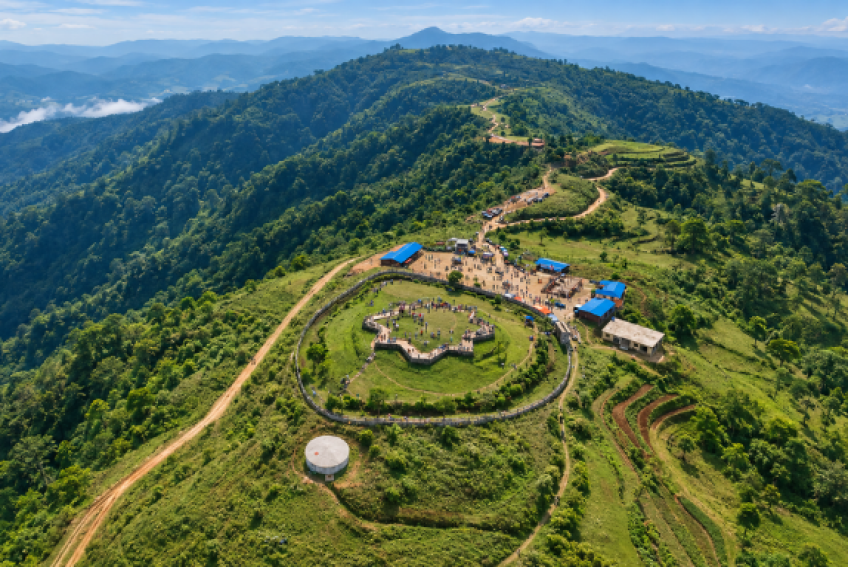
Long before Nepal became a unified nation, the hills of eastern Nepal were home to several independent kingdoms. Among them was Chaudandi, a historic kingdom ruled by the Sen dynasty. Today, its former capital, Chaudandigadhi, stands in Ward No. 1 of Chaudandigadhi Municipality, Udayapur District, Koshi Province.
Situated approximately 3,000 feet above sea level in the Mahabharat Range, the hilltop fort once served as an important political and defensive centre. Its elevated location provided a strategic view of the surrounding hills and valleys.
Chaudandi's history is closely connected to the Sen rulers, whose influence extended across Makwanpur and other parts of eastern Nepal. Historical accounts associate the kingdom's establishment with Jagat Sen, while Karna Sen is remembered as its last ruler.
During King Prithvi Narayan Shah's campaign to unify Nepal, Gorkhali forces captured Chaudandi in the 1770s. Karna Sen reportedly fled towards Vijayapur, bringing an end to the kingdom's independent rule. The former royal centre gradually lost its political importance, leaving behind structures that still recall its past.
Chaudandigadhi is more than an abandoned fortress. A 2023 archaeological study by Shalik Ram Rai, published in Nepalese Culture, documented stone fortifications, historical structures and archaeological objects.
The study describes an unusual octagonal structure within a circular enclosure measuring approximately 31 metres across. Researchers also identified Neolithic stone tools and traditional beads, suggesting human activity in the area may extend thousands of years before the Sen period.
These discoveries highlight the site's significance, although further research is needed to establish the exact age of its earliest structures.
Visitors can explore the surviving stone remains, walk along the hilltop and enjoy views of the surrounding green landscape. The site's quiet surroundings make it appealing to travellers interested in history, archaeology and lesser-known destinations.
The fort is approximately 8 kilometres from Beltar Bazaar and 6 kilometres from Basaha Bazaar, according to the archaeological study. Spring and autumn are generally suitable for exploration, although local road and weather conditions should be checked before travelling.
Chaudandigadhi is a reminder of Nepal's rich history beyond its famous palaces and monuments. Its surviving ruins offer a connection to the Sen dynasty, earlier settlements and the country's political transformation.
With careful conservation, further archaeological research and responsible tourism, this forgotten royal capital has the potential to become an important heritage destination in eastern Nepal.
Kathesimbhu Stupa: Kathmandu’s Miniature Swayambhunath
The Tranquil Beauty Of Jakhera Taal
Bhoot Khola: A Mystical Adventure In Western Nepal
Chautara Sangachokgadhi: Where Nepali Tradition And Modernity Meet
Hiking Gosaithan Hill: A Must-Visit Destination Near Banepa And Dhulikhel