
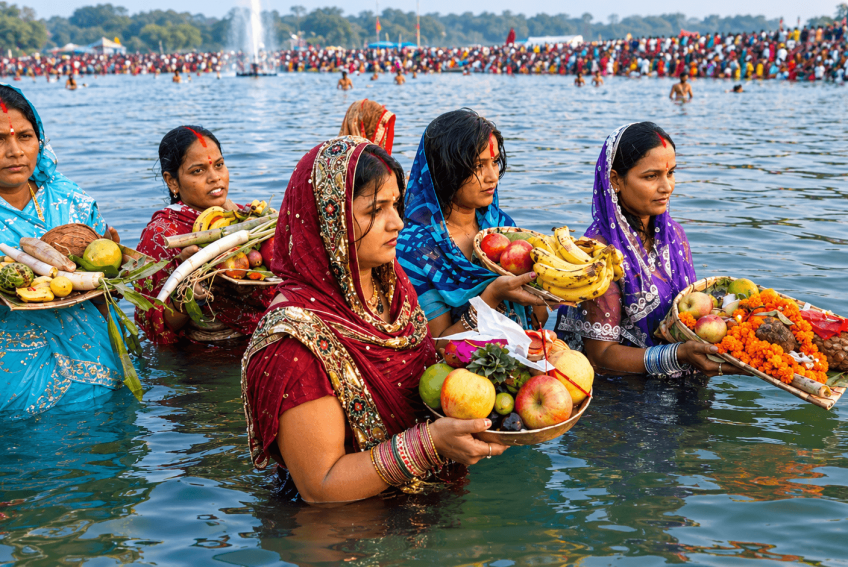
Today, women across Nepal's Terai region observe Jitiya, one of the most demanding and meaningful festivals in the Mithila tradition. Also known as Jivitputrika or Jiutiya, the three-day festival is celebrated by married women of the Maithil, Tharu and Bhojpuri communities, who fast for the long life and well-being of their children. It falls on the seventh to ninth days of the waning moon (Krishna Paksha) in the month of Ashwin, a few days before Ghatasthapana.
Nahay-Khay begins the festival. Women bathe in rivers or ponds and offer mustard oil and khari (mustard oil cake) on sponge gourd leaves to Lord Jimutavahana. In the evening comes the unusual Machh-Madua meal of fish and finger millet bread. Vegetarians skip the fish but still eat millet bread, noni greens or kheer. Millet is otherwise considered humble food, yet here it is given ritual honour.
Khur-Jitiya is the main day, falling on Ashtami. Before sunrise, women eat ongathan, a meal of curd, beaten rice, jaggery and bananas. Then the Nirjala fast begins, with no food and no water for 24 to 36 hours.
Tradition holds that the fast is broken if a woman burps, spits or bites her tongue. In the afternoon and evening, women gather to worship Jimutavahana, plant a branch of the Pakadi (fig) tree, make clay figures of a kite and a jackal, and listen to the festival's stories. In Tharu communities, the day also brings song and the lively Jhamta dance.
Parana ends the fast on Navami. Women bathe, offer fruits and homemade foods to Jimutavahana and their ancestors, and then break the fast with curd, beaten rice and fruits.
Jimutavahana was a Vidyadhara prince who gave up his kingdom to serve his parents in the forest. When he saw the mother of a young serpent, Shankhachuda, weeping because her only son was to be fed to Garuda, he offered himself in the boy's place. Moved by his compassion, Garuda stopped and vowed never to prey on the Nagas again. This story also appears in Emperor Harsha's seventh-century play Nagananda.
The folk tale tells of a jackal and a crow (or eagle) who vowed to fast. The jackal secretly ate the flesh of a cremated body and broke the fast. In their next lives, as sisters, one had healthy sons while the other lost her child. This is why women guard the fast so carefully.
Jitiya is a living example of Lokveda, a tradition where the folk, and especially mothers, shape the soul of the faith. It also has a rare feature called Pitarain, in which women remember and make offerings to their deceased mothers, mothers-in-law and other female ancestors. Male ancestors are honoured during Pitru Paksha, but there is no separate ritual for women, so this tradition fills the gap.
The festival also reflects respect for nature. Ponds, fig trees, gourd leaves, mustard oil, millet, fish, kites and jackals all have a place in the worship. The millet is nutritious, and the fish makes a hearty meal before a long fast.
Many people say that if someone survives a serious accident, "his mother must have observed Khar Jitiya." That saying captures the faith in a mother's penance.
Jitiya is also a gathering of community and memory, passed from one generation of women to the next. As awareness of equality grows, it is now widely understood as a festival for the welfare of all one's children, sons and daughters alike.
To all the mothers observing the fast today, we wish strength, patience and blessings for their families.


.png)