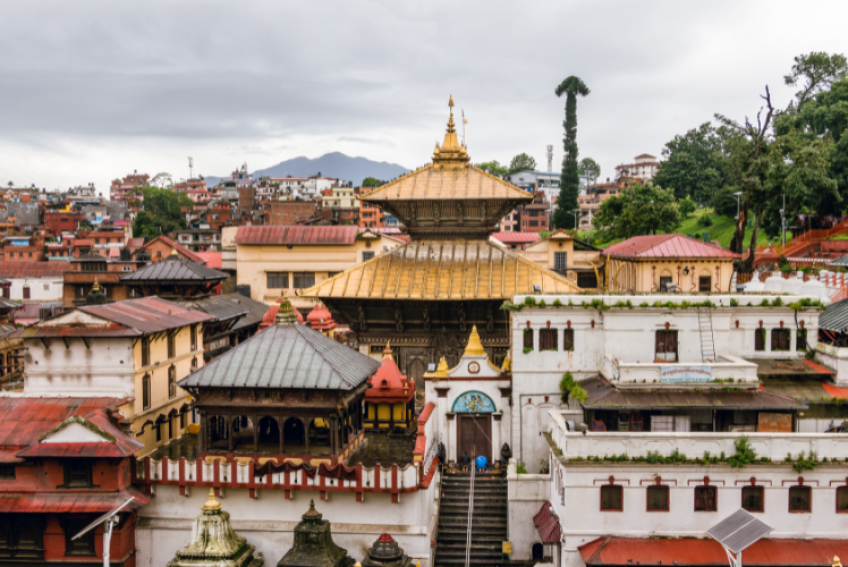
On the banks of the Bagmati River in Kathmandu stands Pashupatinath, the oldest and most sacred Hindu temple in Nepal. Pilgrims arrive by the thousands, especially during Maha Shivaratri, to stand before a black stone linga that doesn't just sit in the sanctum — it looks back. Four faces, carved into the stone, gaze out toward the four cardinal directions. A fifth, unseen and unseeable, is said to face the sky.
This is the Chaturmukha, or "four-faced," linga — technically a Panchamukha when you count the hidden fifth face. And of the four visible ones, the face turned south is the one people ask about most. It's called Aghora, and it belongs to Shiva's fiercest, most unsettling aspect.
Before getting to the south, it helps to see the whole circle. Each face of the Pashupatinath linga represents a different aspect of Shiva, a different element, and a different domain of life:
Together these five make up the Panchabrahma, the five faces of Shiva that Shaiva philosophy treats as a complete map of the universe: birth, sustenance, knowledge, dissolution, and transcendence, folded into one deity looking every direction at once.

In Hindu cosmology, south isn't a neutral compass point. It's the direction ruled by Yama, the god of death, and it's the direction bodies are traditionally not pointed toward in life — you don't sleep with your head facing south, and doorways facing south are treated with more caution than those facing other ways. South is where endings live.
That's exactly why Aghora belongs there. Aghora, the name literally means "not terrible" or "without fear," a kind of deliberate understatement, is Shiva in his most destructive form: the burner of ego, the dissolver of illusion, the face associated with cremation grounds, fire, and the fierce work of tearing down what needs to end before anything new can begin. Placing this face toward the direction of death isn't an accident of architecture. It's the temple's way of putting the hardest truth in the room where it belongs, facing the direction people are most afraid to look.
There's a practical echo of this too: Pashupatinath sits directly beside the Bagmati's cremation ghats, among the busiest in South Asia. Devotees are cremated within sight of the temple, and the Aghora face: destruction, impermanence, the burning away of the physical — presides quite literally over that threshold.
Temple tradition doesn't leave the sequence to chance either. When devotees are guided through worship of the four-faced linga, the customary path begins at the south, with Aghora, before moving to east (Tatpurusha), then west (Sadyojata), and finally a partial glimpse of north (Vamadeva). You meet destruction first. Only after facing that do you move toward knowledge, prosperity, and finally the gentler, nourishing face of preservation.
It's a small ritual detail, but it carries the same logic as the temple's iconography: you don't get to the creative and sustaining aspects of the divine without first reckoning with the fierce one. Aghora isn't cruelty for its own sake, in the Aghora tradition broadly, this face represents the courage to face what's frightening (death, ego, illusion) without flinching, which is precisely why the name insists it isn't terrible at all.

Strip away the direction and the drama, and Pashupatinath's four faces are really doing one thing: refusing to let devotees worship a sanitized, single-note divinity. Shiva here is creator and preserver, yes, but also the fire that ends things. The temple doesn't tuck that fierce face away — it gives it its own cardinal direction, its own name, its own place at the start of the ritual circuit. Aghora faces south not because Shiva is more terrifying there than anywhere else, but because the temple wanted every pilgrim to walk past death, deliberately, on the way to everything else.

.jpg)
.jpg)