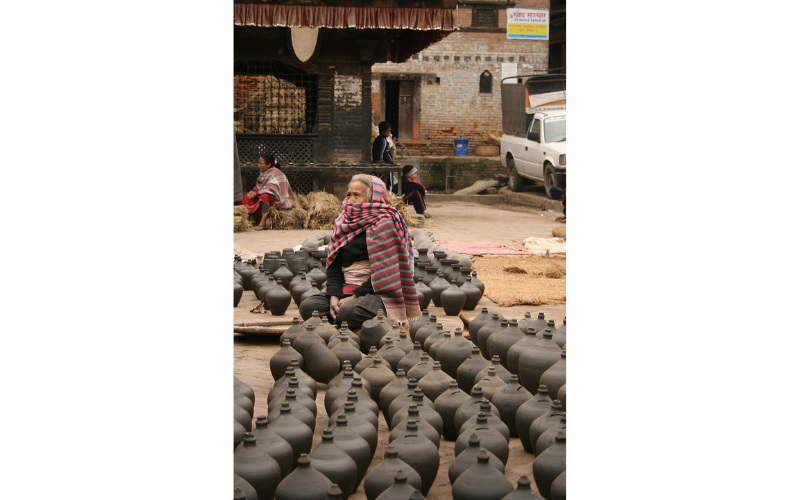
Drive east out of Kathmandu toward Bhaktapur and, before you reach the medieval city's ancient gates, you will pass through Thimi. To the casual eye, it is just another Newari town – dense, historic, fragrant with incense and cooking fires. But stop and look closely at the courtyards, and you will find them stacked with terracotta: flower pots, water jars, ritual vessels, and painted figurines drying in the sun. Thimi is one of the Kathmandu Valley's most important pottery centers, home to a tradition that stretches back at least five centuries.
Most of Thimi's potters belong to the Prajapati community – a caste whose very name derives from Prajapati, the Hindu creator deity. The craft has been passed from parent to child for as many generations as anyone can remember. Boys learn to center clay on the wheel before they go to school; girls learn to paint and fire almost as soon as they can hold a brush. The knowledge is embodied – in the hands, in the wrists, in the rhythm of the foot-kick on the wheel.
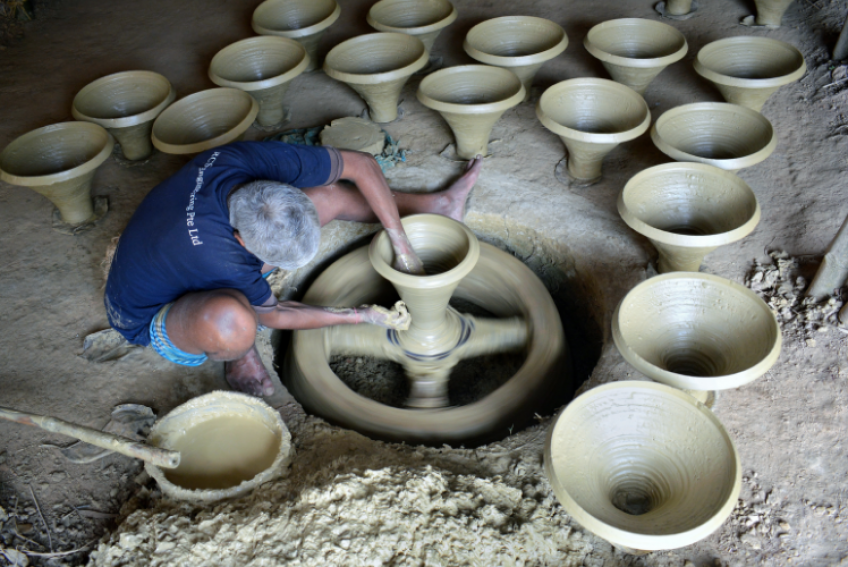
The traditional kick-wheel, or chakra, remains the tool of choice for most artisans. There is no mechanical assistance. The potter kicks the heavy stone flywheel with one foot, maintaining a steady spin while both hands coax the rising clay into form. Watching an experienced Prajapati potter work is to witness a kind of moving meditation – quiet, precise, unhurried.
Thimi potters produce a remarkable range of objects. Everyday items – gagri (water vessels), chatti (cooking pots), flower planters – form the economic backbone of the trade. But it is the ceremonial and decorative work that draws collectors and tourists. Thimi is especially known for its painted clay masks of deities such as Kumari, Bhairav, and Ganesh, and for the peacock-adorned flower pots that have become something of a valley trademark.
During festivals, particularly the Bisket Jatra celebrations in Bhaktapur, demand for ritual clay objects surges and potters work through the night.
Thimi is renowned as Nepal’s premier pottery and crafts village, and organizations like UNESCO have flagged its intangible cultural heritage for protection. But the potters themselves are clear-eyed about what it takes to survive: the craft must remain economically viable, not merely culturally celebrated. When a family can earn a living wage from clay, the wheel keeps turning. That, in the end, is the only preservation that matters.
And yet, there is resilience here too. Thimi potters have adapted – producing contemporary designs for the export market, collaborating with NGOs and designers, and benefiting from a renewed global appetite for handmade, sustainable objects. A number of workshops now offer pottery classes to tourists, and the income helps keep families at the wheel.