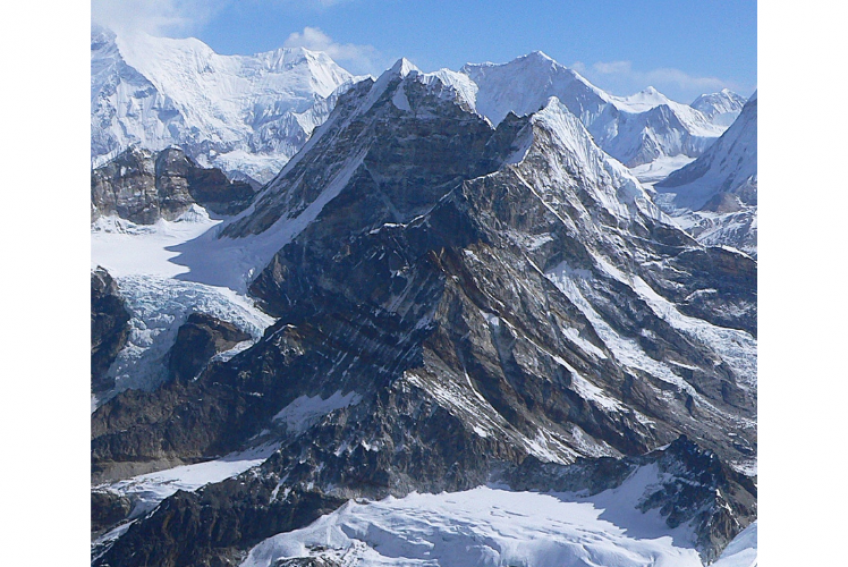
Everest isn't finished. The ongoing collision between the Indian and Eurasian tectonic plates pushes the peak upward by roughly a few millimetres each year, even as erosion works against it. A 2020 joint Nepal–China survey fixed its official height at 8,848.86 metres, later widely reported as 8,849 metres; a rare case of two rival nations agreeing on a mountain's exact size.
To the world it's Everest, named after British surveyor Sir George Everest. But in Nepal, it's Sagarmatha, meaning "Forehead of the Sky." Tibetans call it Chomolungma, "Goddess Mother of the World." Locals rarely use the English name at all.
For centuries, Nepal was closed to foreign climbers. It wasn't until 1949 that the country opened its peaks to international mountaineering; and just one year later, in 1950, French climbers Maurice Herzog and Louis Lachenal became the first humans to summit an 8,000m peak anywhere in the world: Annapurna I.
Most people assume Everest was the first Himalayan giant to fall – it wasn't. Annapurna I was summited in 1950, three full years before Hillary and Tenzing reached Everest's top in 1953.
Despite being the first eight-thousander ever climbed, Annapurna I remains the most dangerous. Its fatality rate has historically hovered around 32% of summiteers — the highest of any peak in this elite category – due to unstable weather, avalanche-prone slopes, and massive hanging seracs.
Before modern surveying, Kanchenjunga held the "world's highest mountain" title from 1838 to 1849. It's now confirmed as the third highest at 8,586 metres, straddling the Nepal–Sikkim (India) border.
Kanchenjunga translates to "The Five Treasures of the Great Snow," referring to its five distinct summits. Local Limbu, Rai, and Sherpa communities consider the entire massif sacred, believed to house guardian deities.
Nicknamed "Fishtail" for its twin-pronged peak, Machapuchare (6,993m) near Pokhara is considered so sacred to Lord Shiva that Nepal has banned climbing to its true summit since a British team stopped just short of the top in 1957. It remains one of the most photographed, least climbed mountains in the world.
In an official 2025 update, Nepal's peak profile database recognised six additional subpeaks as legitimate eight-thousanders, bringing the country's total from 8 to 14 (when counting satellite summits like Kanchenjunga Central, Yalung Kang, and Lhotse Middle). International bodies are still reviewing full recognition.
Located just beside Everest, Lhotse Middle held the record as the highest unclimbed point on Earth for decades due to its lack of an independent ridge, finally being summited only in the 2000s.
Geologically speaking, the Himalayas are babies – formed only around 50 million years ago when the Indian tectonic plate slammed into Eurasia. Compare that to the Appalachian Mountains, which are over 480 million years old.
Relatively speaking. Cho Oyu (8,188m) is considered the most technically approachable eight-thousander via its Northwest Ridge route, making it a common choice for climbers attempting their first 8,000m summit – though "easy" at this altitude is always relative.
Beyond the "eight-thousander" club, Nepal claims eight of the world's top ten highest mountains outright – an unmatched concentration of extreme altitude found nowhere else on the planet.
You don't need technical climbing skills to stand at the foot of the world's highest mountain. The Everest Base Camp trek – no ropes or oxygen required – attracts tens of thousands of trekkers annually, making it one of the most popular high-altitude walks on Earth.
Known as the "Himalayan Pyramid," Makalu (8,485m) rises as an isolated, four-sided peak just 19km east of Everest – one of the most strikingly symmetrical mountains in the range.
Before Everest and Kanchenjunga were properly surveyed, Dhaulagiri (8,167m) held the "world's highest" title in Western geographical records for over 30 years in the 19th century.
Between Annapurna and Dhaulagiri lies the Kali Gandaki Gorge – one of the deepest gorges on Earth, deep enough to separate the Himalayas into distinct western and eastern geological sections.
Generations of high-altitude life have given the Sherpa people unique physiological adaptations – including more efficient oxygen use in the blood – that give them a genuine biological advantage on Himalayan expeditions, a subject of ongoing scientific research.
The high-altitude zones of these peaks aren't lifeless. They shelter endangered snow leopards, Himalayan black bears, red pandas, and blue sheep, alongside unique alpine flora found nowhere else.
As of recent counts, Nepal's Department of Tourism has opened over 414 peaks to climbers, jointly regulated with the Nepal Mountaineering Association – meaning the eight-thousanders are just the tip (literally) of what's available.
At 6,812m, Ama Dablam isn't an eight-thousander, but its dramatic, jagged silhouette near Everest makes it one of the most photographed and beloved peaks among climbers worldwide.
Even with monsoon rains, glacial melt, and seismic activity constantly wearing the range down, tectonic uplift still outpaces erosion – which is why the Himalayas, unlike older ranges, continue to climb higher over time.
From the Kali River in the west to the Tista River in the east, the Nepal Himalaya spans roughly 800km, forming the highest and most dramatic central section of the entire Himalayan arc across five countries.
Whether you're planning a base camp trek, a peak-climbing expedition, or simply want to understand what you're looking at from a Pokhara rooftop at sunrise, these facts turn distant snowy silhouettes into stories with names, records, and meaning.