Glaciers move like slow, immense sheets of sandpaper. As they slide over bedrock, embedded rock fragments grind the stone beneath into an extremely fine powder called rock flour, or glacial flour. The particles are tiny, in the silt and clay range, and that size is the whole story. Anything that small does not sink. It stays suspended in meltwater almost indefinitely, which is why glacial rivers rarely run clear.
A river flowing straight off an active glacier, like the Dudh Koshi below the Khumbu and Ngozumpa glaciers, is carrying a heavy, mixed load of this sediment with little chance to settle. Larger silt particles scatter light across a broad range of wavelengths rather than favoring blue, so the water reads as grey, brown, or milky white. The effect gets stronger in spring and early summer, when higher melt rates push more sediment into the flow, and eases off after the monsoon once glacial input slows. The Trishuli and the upper Kali Gandaki show the same pattern: they run close to their glacial sources, with little basin to filter the load before it reaches the water you see from the trail or the raft.
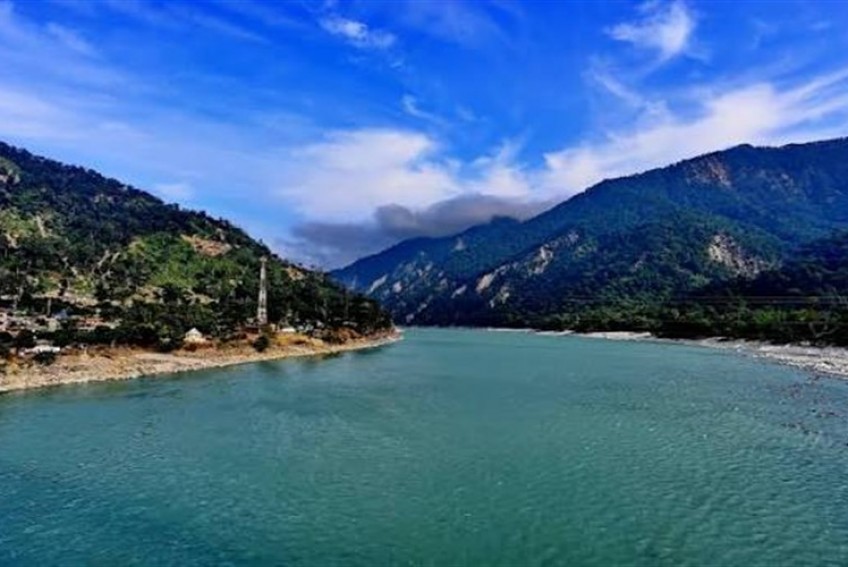
Send that same sediment-laden meltwater into a lake basin, and the picture changes. The lake acts as a settling pond. Heavier particles drop to the bottom while the very finest rock flour, just a few microns across, stays suspended near the surface. At that scale, particles scatter blue and green wavelengths far more efficiently, an optical effect known as the Tyndall effect. That is why the Gokyo lakes, fed by the Ngozumpa Glacier, hold a vivid blue-green even though the glacier itself feeds grey, silty streams. The same logic explains the turquoise of Phoksundo and Gangapurna, both essentially glacial settling basins with a view.
Pokhara's Seti River complicates the pattern nicely. Its name literally means white, and its color comes less from classic rock flour than from fine limestone and marble sediment eroded from the Annapurna and Machhapuchhre massifs, carved through the narrow gorges the river has cut over thousands of years. It is glacial in origin but limestone in color, a reminder that Himalayan geology rarely offers one clean explanation for anything.
None of this is just trivia for a viewpoint caption. It explains why rafting the Bhote Koshi in June looks nothing like rafting it in October, and why lake photography in the Everest and Annapurna regions rewards patience: wait for a low-sediment window, usually autumn, and the turquoise gets almost too saturated to look real. Grey water and turquoise water are not competing signs of a healthy or unhealthy river. They can come from the exact same glacier, separated only by whether a lake basin got in the way first.