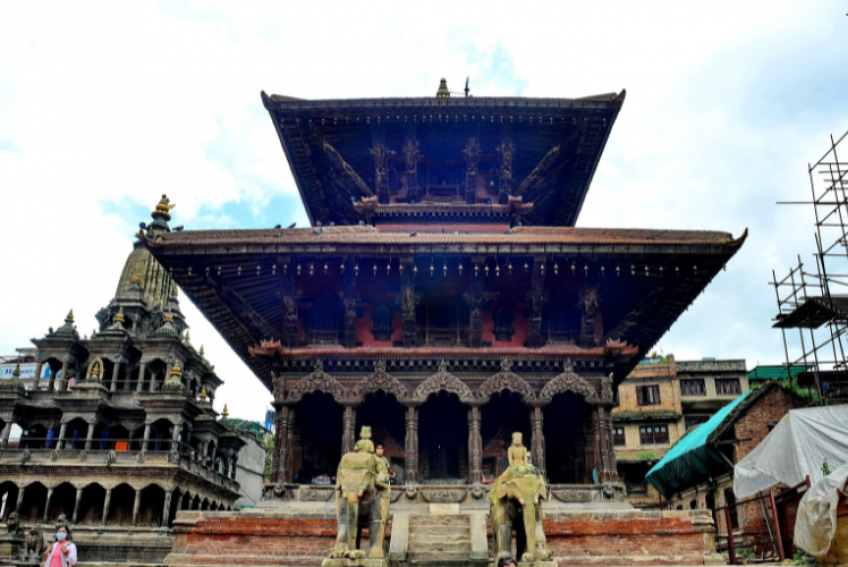
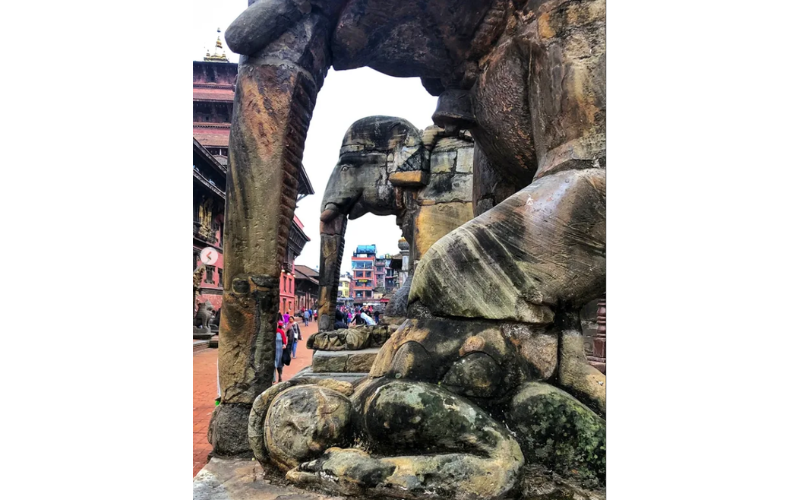
Ever noticed the carving of a man beneath a stone elephant at the Vishwanath Temple in Patan Durbar Square?
At first glance, it is easy to miss; just another intricate detail in the layered stonework of the Malla period. But look closer, and you find a scene that has sparked curiosity, interpretation, and storytelling for generations.
A Temple of the Malla Era
The Vishwanath Temple was built in 1627 CE under the patronage of Siddhi Narasimha Malla, one of the influential rulers of the Malla dynasty. Located within the historic core of Patan Durbar Square, the temple reflects the artistic refinement and symbolic depth characteristic of Newar craftsmanship.
At its eastern entrance stand two carved stone elephants, traditional guardians in South Asian temple architecture. Beneath one of them lies a small human figure pressed into stone: a detail that has long invited interpretation.
Legend, Memory, and Interpretation
Local oral traditions associate this figure with Shamsuddin Ilyas Shah, the founder of the Bengal Sultanate, who is believed to have led a military incursion into the Kathmandu Valley in 1349 CE.
Historical chronicles suggest that this raid did occur and caused widespread destruction across parts of the valley. However, historians also note that direct visual representation linking this temple carving to that event is not conclusively documented.
Instead, the sculpture is more widely understood within the framework of symbolic temple art, where elephants represent strength, protection, and divine guardianship. The figure beneath them is commonly interpreted as a symbol of suppression of evil, ego, or disorder, rather than a specific historical individual.
Between History and Symbolism
What makes the carving compelling is not a confirmed identity, but its layered meaning. In the Malla period, temple art often communicated ideas through metaphor rather than literal representation. Power, protection, and moral order were expressed through visual hierarchies: divinity above, chaos subdued below.
In this context, the Vishwanath Temple carving becomes less about a named invader and more about a broader worldview: the triumph of order over disruption, and continuity over destruction.
A Living Urban Memory
Patan Durbar Square today stands as a UNESCO-recognised cultural landscape, where temples, courtyards, and shrines continue to shape everyday life. Within this setting, such carvings are not static artefacts but active carriers of memory, shaped equally by history, belief, and storytelling.
The story of the man beneath the elephant endures precisely because it sits at the intersection of fact and folklore where Kathmandu Valley’s history is often preserved not only in inscriptions, but in interpretation passed through generations.
Whether viewed as symbolic art or linked through legend to historical events, the carving at Vishwanath Temple reflects a deeper truth about Patan itself: its history is not only built in stone, but also in memory, narrative, and meaning-making.
In the quiet pressure of the elephant’s foot, the city preserves a reminder, not of a single man or moment but of how societies remember, reinterpret, and retell their past.
Also Read