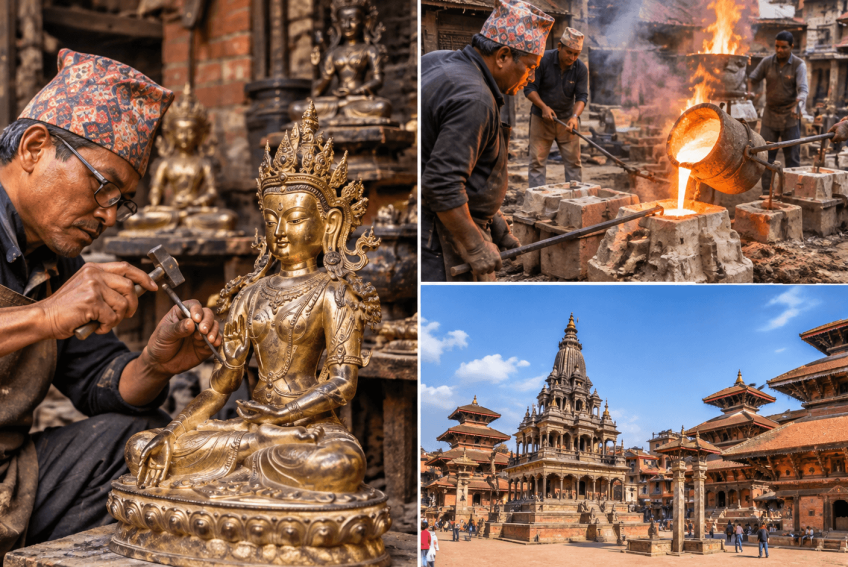
In the narrow streets of Patan, Lalitpur, the rhythmic sound of chisels striking metal tells a story that stretches back centuries. Behind traditional brick buildings and modest workshops, skilled Newar artisans continue practising Thajya, the ancient lost-wax metal casting technique used to create intricate Buddhist and Hindu sculptures. For travellers exploring Nepal’s cultural heritage, Patan offers a rare opportunity to discover how traditional craftsmanship, spirituality and history remain connected.
Located in the southeastern Kathmandu Valley, Patan has long been recognised as an important centre of Nepalese metal sculpture. Its artistic heritage dates back at least to the Licchavi period (approximately 400–750 CE), while royal patronage during the Malla period (approximately 1201–1779 CE) helped the craft flourish. Historically, artisan families, particularly the Shakya and Tamrakar communities, preserved these specialised skills across generations.
The city's artistic influence extended far beyond Nepal. From the medieval period, Newar craftsmen produced religious sculptures for Tibetan monasteries. One celebrated figure was Araniko, the 13th-century Nepalese artist whose work in Tibet and China helped spread Himalayan artistic traditions.
What makes Patan's metalwork extraordinary is its meticulous production process. Artisans begin by shaping a detailed model using beeswax, vegetable oil and natural resin. The wax sculpture is then covered with layers of clay and other traditional materials before being heated to remove the wax. Molten copper or bronze is poured into the resulting cavity, often at temperatures exceeding 1,000°C.
Once cooled, the clay mould is broken to reveal the sculpture. Craftsmen then spend days or weeks engraving delicate facial expressions, jewellery, clothing and symbolic details. Some statues receive gold gilding, while others are decorated with colourful stones. Religious sculptures may also undergo consecration rituals before being placed in temples or private shrines.
For visitors, the historic neighbourhoods surrounding Patan Durbar Square, Mangal Bazaar and Oku Bahal provide a fascinating introduction to this living tradition. Beyond the city's celebrated temples and courtyards, traditional metalworking workshops reveal another side of Patan's cultural identity. Travellers can explore local craft shops, observe artisans where visits are welcomed and learn about the patience required to create handmade sculptures.
However, this heritage faces growing challenges. Mass-produced replicas, changing markets and the demanding nature of traditional craftsmanship threaten the continuity of specialised skills.
Patan is more than a destination for ancient monuments. It is a living centre of Nepalese creativity, where centuries-old techniques survive through the dedication of skilled hands. Every carefully crafted statue carries a story of artistic knowledge, cultural identity and spiritual devotion.
For travellers seeking authentic cultural experiences in Nepal, Patan offers something unforgettable: the opportunity to witness history still being made.