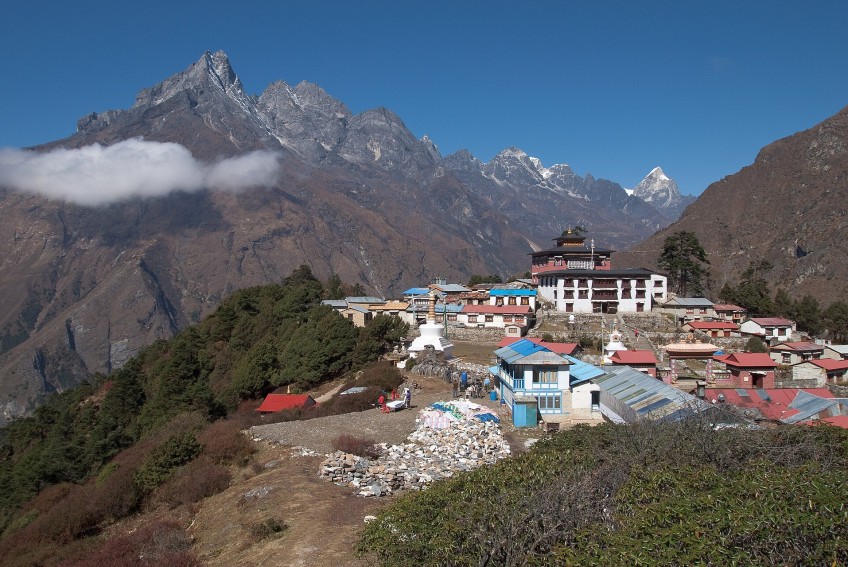
Sits at 3,867 metres (12,687 ft) in the Khumbu region of eastern Nepal, Tengboche Monastery also known as Dawa Choling Gompa is the largest gompa in the region and one of the most revered stops on the Everest Base Camp trail. Set inside Sagarmatha National Park, a UNESCO World Heritage Site, the monastery sits on a ridge at the confluence of the Dudh Kosi and Imja Khola rivers, offering panoramic views of Everest, Nuptse, Lhotse, Ama Dablam, Thamserku, and Tawache.
Tengboche was founded in 1916 by Lama Gulu, blessed by Ngawang Tenzin Norbu, who had earlier established the Rongbuk Monastery on the Tibetan side of Everest Tengboche's spiritual "mother monastery." It became the first celibate monastery of the Nyingmapa lineage of Vajrayana Buddhism in the region.
The monastery has twice risen from disaster. An earthquake destroyed it in 1934, and it was rebuilt under Lama Gulu's successor, Umze Gelden, with support from a skilled carpenter from Lhasa and murals painted by the artist Kappa Kalden. In 1989, an electrical short circuit sparked a devastating fire that destroyed its scriptures, statues, and wood carvings.
It was rebuilt again with worldwide donations, under the guidance of Nawang Tenzing Jangpo, and formally consecrated in 1993. Support came from the Sir Edmund Hillary Himalayan Trust, the American Himalayan Heritage Foundation, and other international donors; the entrance gate was later rebuilt with funding from the Washington-based Greater Himalayas Foundation.
Tengboche's fame grew after Tenzing Norgay and Sir Edmund Hillary passed through en route to the first successful summit of Everest in 1953. Since then, expeditions have continued the tradition of visiting the monastery to seek blessings before attempting the mountain.
The main prayer hall, or Dokhang, houses a two-storey statue of Shakyamuni Buddha flanked by Manjushri and Maitreya, along with the Kangyur scriptures. The site is surrounded by mani stones inscribed with "Om Mane Padme Hum" and prayer flags representing the five Buddhist elements.
A short walk downhill leads to Devoche, a small nunnery established after nuns who once studied at Tengboche sought a place of their own; it now houses only a handful of nuns.
Today, roughly 60 monks reside at Tengboche, though fewer young Sherpa boys are joining monastic life as many turn to mountaineering and trekking work instead.
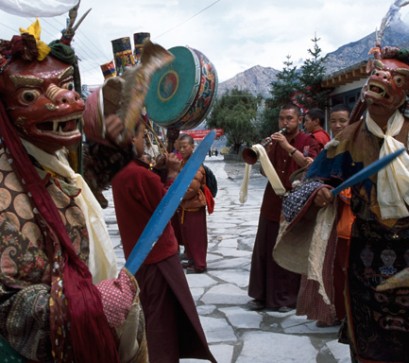
Tengboche's biggest cultural draw is the Mani Rimdu festival, held during the tenth lunar month of the Tibetan calendar (October–November). Over 19 days, monks create an intricate sand mandala, perform masked "Cham" dances depicting the triumph of Buddhism over demons, and distribute blessed red pills to devotees. The festival, inherited from Rongbuk Monastery, draws large crowds of trekkers.
Reaching Tengboche typically requires a three-to-four-day trek from Lukla, Khumbu's nearest airport, via Namche Bazaar. The monastery welcomes an estimated 15,000 visitors annually, with numbers peaking at around 600 per week during high season.

.jpg)
.jpg)