
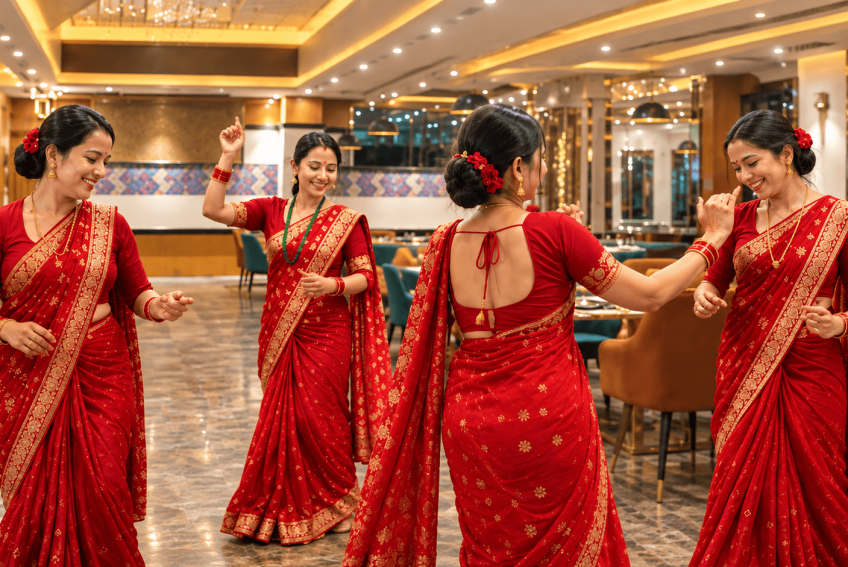
Teej is best known as a festival of fasting and devotion, but at its heart it is also a festival of voice. For generations, the songs and dances of Teej have given women a rare public stage to express joy, grief, humor, and rebellion. Here are six things about this musical tradition that might surprise you.
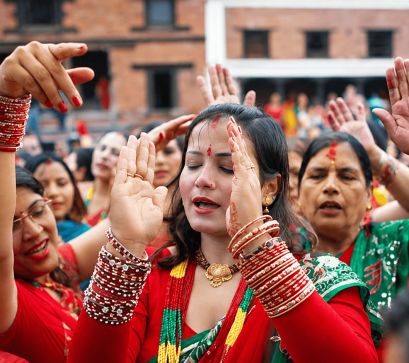
Long before social media, Teej songs gave women one of the few culturally accepted outlets to speak openly about hardship, difficult in-laws, restrictive customs, and the pressures of married life. Singing together in groups turned private frustration into shared, public solidarity.
The emotional arc of Teej is dramatic. Early songs, often called Biraha, dwell on the sadness of leaving one's childhood home after marriage. But as the festival progresses, the tone flips entirely, turning into energetic, joyful singing and dancing that feels like an emotional release valve.
Perhaps the most physically astonishing part of Teej is that women often dance for hours during a strict waterless fast (Nirjala Vrat). The collective rhythm, drumming, and shared energy of the group appear to carry dancers through fatigue that would otherwise be hard to sustain.
While rooted in traditional tunes, Teej songs are often improvised in real time. Women form circles and trade verses back and forth, weaving in family gossip, community news, and inside jokes turning an old melody into something completely new each time it's sung.
Teej music hasn't stayed frozen in the past. Modern versions now tackle themes like women's rights, consumer culture, politics, and the experience of husbands migrating abroad for work. What began as village folk tradition has evolved into a living genre that still comments on current life.
The circular dance formation carries real symbolic weight. With no clear front or back, everyone in the circle stands as an equal. It represents the community of women supporting one another, a kind of sacred, protective boundary where every voice is heard.
Rooted in the mythology of Parvati's devotion to Shiva, Teej is often described as a festival about marriage and fasting. But its music tells a fuller story, one of grief and joy, individual voice and collective strength, old ritual and modern relevance, all carried through a single, unbroken circle of song.

 (1).png)




.jpg)