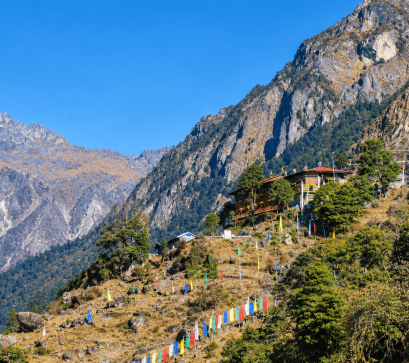
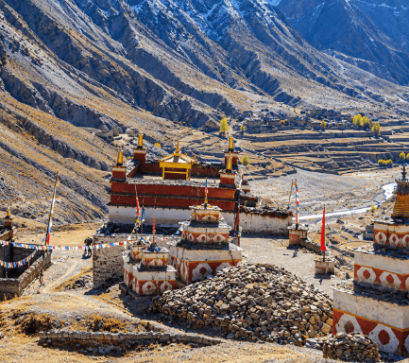
Across the Himalayas, Buddhists, Hindus and Jains walk clockwise around sacred sites. In Upper Dolpo, the followers of Yungdrung Bon, Tibet's pre-Buddhist tradition, walk the other way. They keep the shrine, the mani wall or the holy mountain on their left. It is the first thing a visitor notices and the last thing a Bonpo would call unusual.
For Bonpos, the counter-clockwise turn is a movement back toward the source of existence. The clockwise turn is read as an outward spreading of knowledge. The same logic shapes the Yungdrung, Bon's left-facing swastika, which stands for timelessness and the eternal rotation of existence.
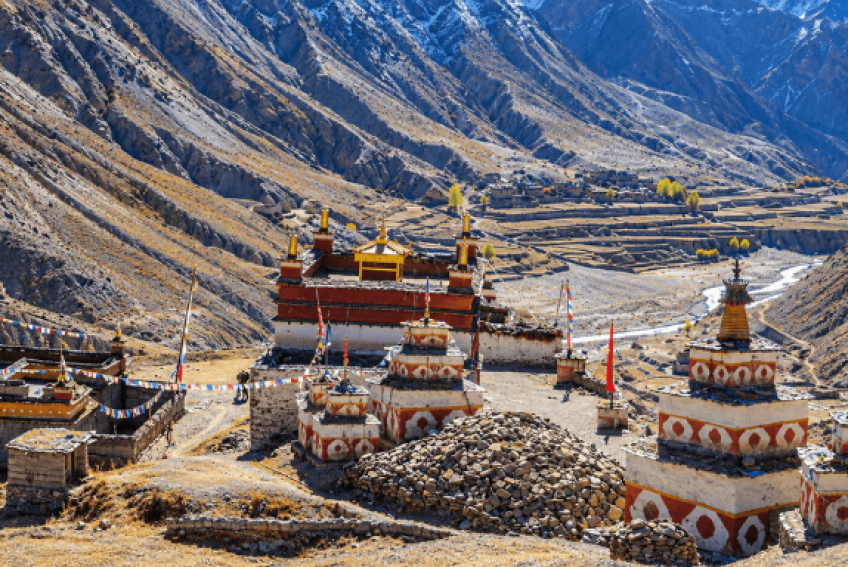
The direction runs through daily practice. Prayer wheels in Bon sanctuaries such as Samling Gompa are spun to the left, and the mantra Om Ma Tri Mu Ye Sa Le Du replaces Om Mani Padme Hum. Chortens and prayer flags may look the same in both traditions, but the way people move around them is not.
In Dolpo, ritual is a way of keeping peace with the land. Villagers honour local deities and water spirits. Harming a stream, a tree or a peak is believed to bring failed harvests, sick livestock or violent storms.
Offerings are the daily language of this relationship. In the Pungmo valley, animals were once sacrificed to a local spirit. Local tradition holds that the Bon master Treton Tsewang Tsultrim subdued the spirit and replaced the blood offerings with tsampa and butter. Bon priests remain vegetarian today.
Lamas also serve as healers, using divination, herbs and mantra recitation to treat illness. In seasonal festivals, masked cham dances and fire pujas are performed to drive away harmful spirits. Even death is shaped by the elements. A lama calculates which element a person belongs to, and the funeral is chosen accordingly: sky, water, fire or earth.
Samling Gompa, founded in 1183, is Dolpo's great seat of Bon learning, where Dzogchen masters have long practised. Dho Tarap holds Deden Phuntsok Ling and Riwo Bumpa Gonpa, a monastery shared by both faiths, with Bon and Buddhist deities side by side on its walls. Near Shey, pilgrims circle Crystal Mountain, most memorably at the Shey Festival, held in the Dragon year. The last was 2024, and the next falls in 2036.
Despite the contrasts, Upper Dolpo is a place of synthesis, not rivalry. Families often follow elements of both faiths, and neighbours join each other's rituals with quiet respect.
Upper Dolpo is a restricted region, so permits are required. The trekking season runs from May to October. Ask before photographing inside monasteries and dress modestly. At any shrine, watch which way the locals circle and follow their lead.
The tradition faces pressure as young people leave for study and work, but schools and monastery teaching are helping to hold it in place. For now, the loops are still being walked, step by step, toward the origin.
.png)