
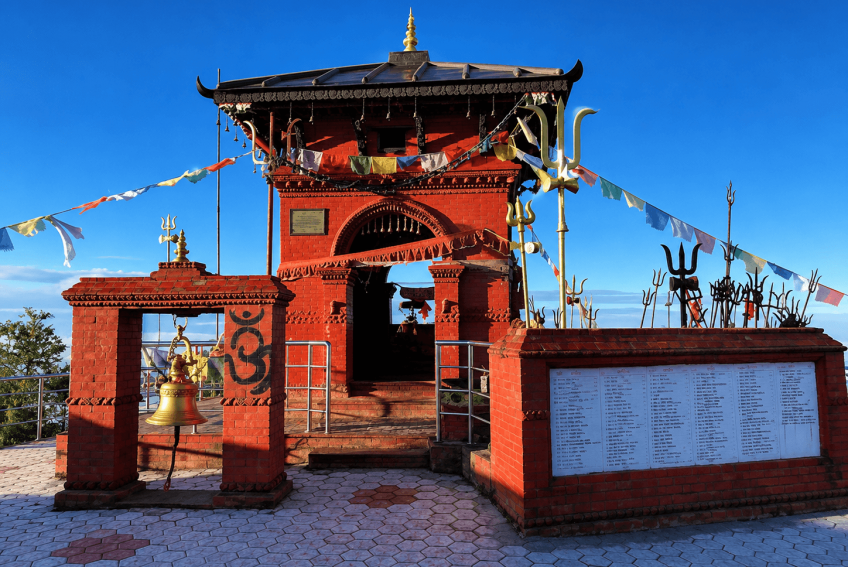
While Kathmandu Valley's older Shiva temples draw crowds year-round, Kaleshwor Mahadev remains relatively unknown outside the immediate region, which is part of its appeal. The temple sits in Mahankal Rural Municipality in southern Lalitpur District, an area that was formerly its own village development committee called Kaleshwar.
According to local belief, the site's origin ties back to Hindu mythology: when a grieving Lord Shiva carried the body of his consort Sati Devi across the universe, her throat is said to have fallen at this hilltop, and a self-manifested Shiva Linga formed here as a result. That story is central to why the temple is considered especially significant for devotees seeking blessings related to overcoming untimely death.
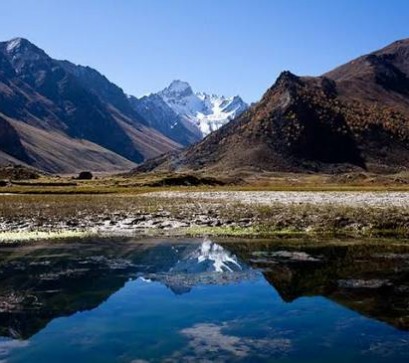
The temple occupies a forested ridge above Gotikhel village, which lies about 45 to 50 kilometres from Kathmandu at the base of the climb. From the hilltop, the view opens north across the Kathmandu Valley and south toward the flat Terai plains, with distant Himalayan peaks visible on clear days, most reliably in the morning before cloud builds up.
The hillside is covered in pine and oak forest, which shades most of the trail up to the temple. Rhododendrons bloom across the surrounding hills in spring. Visitors commonly report birdsong along the walk and occasional sightings of monkeys in the trees; otherwise the forest is quiet, with little traffic beyond the wind.
The temple draws its largest crowds during Shrawan (July–August), when devotees climb up to offer milk and flowers to Shiva, and again during a dedicated fair held on Chaitra Purnima in March or April. Outside these periods, visitor numbers are modest, and the site functions more as a local pilgrimage spot than a tourist attraction.
Getting there takes some planning. By private vehicle, the route runs from Satdobato through Lele, Nallu, and Bhardeu to Gotikhel, then continues on a steep, narrow off-road track to a high point called Sano Gotikhel or Deurali, where the road ends and a 20 to 25-minute walk through pine and oak forest leads to the top.
Public buses run from Chapagaun Buspark, reached via Lagankhel, and take 3 to 4 hours to Gotikhel; from there it's roughly a 2-hour uphill hike. A longer alternative starts from the nearby Baitarni Dhaam temple, adding about 1 to 1.5 hours of forest trekking before joining the same hilltop path.
The dry months from October through February, along with spring and autumn, are the most manageable times to visit, since monsoon rain between June and September turns the trails muddy and can wash out sections of the path. There are very few shops or eateries near the hilltop, so carry your own drinking water, snacks, and sturdy trekking shoes before setting out.


.jpg)